
Blog
Children’s Check-Up: When and Why?
Being a parent isn’t the easiest thing in the world, and that’s partially down to the sheer amount of care that goes into raising a child. We all know it’s not as simple as feeding them food and keeping them safe and entertained; it’s also taking them to their regular doctor and dentist checkups. Which leads to; how often should I book my children’s check-up? At Dental Care Ireland encourage that children come in for at least two checkups every year.
Why do children need bi-annual checkups?
Preventive Care Vs Treatment
As children grow, they can potentially experience problems such as misaligned bites, tooth decay, and teeth growing in crooked. By coming in for a regular children’s check-up, we can assess their teeth and catch problems before they become, well, problems.
Establish Good Habits
It’s common for children to be resistant to brushing their teeth. However, by bringing your children in for a regular children’s check-up, we can instill a desire and a habit to practice good oral hygiene which can carry through into adulthood. If you still hate flossing as an adult, it might be because you didn’t establish this good habit at a young age!
Determine Need for Braces
Not every child is going to need braces, but you won’t be able to tell without the help of a children’s dentist. Dental Care Ireland offer orthodontic services at several locations across the country that can determine if braces are necessary. This will help you get a head start on the orthodontic process, and you may even prevent future issues!
If you would like to schedule your child’s next checkup with us, you can contact your local Dental Care Ireland practice or book online today. Of if you wish to learn more about your children’s oral health, why not check out our Children’s Dentistry page.
Back to School: Healthy Lunchbox Ideas!
It’s that time of year again – long winter nights and busy early mornings. Transitioning back to school will be a little challenging this year, but every little helps, so we’ve put together some ideas for some healthy lunchboxes for the kids.
Sandwiches: No school lunch box blog would be complete without mentioning a classic – the sandwich. Sandwiches don’t have to be boring. Check out some the recipes below for some healthy meat-free and even bread-free options!
Bread-Free: If your child has a wheat allergy or you’d prefer not to give them bread every lunchtime, you could check out some alternatives. For example, you could wrap up some filings in iceberg lettuce leaves or roll up some salad in a slice of meat, offering an easy alternative to the bread sandwich.
Meat-Free: Most kids love a good ham sandwich but if your child is vegan or vegetarian, check out this creative blog for vegan sambos. The Happy Pear is also always good for meat-free options.
Bento Box: Anybody who’s been to Yo Sushi with the kids will know how much they love it and Sushi is generally a healthy option! So why not turn the lunchbox into their very own Bento Box. You can buy Sushi in most supermarkets these days, or you can make it yourself and make it as colorful as you like but beware – this one will take a bit more preparation! Click here for some ideas.
Yoghurt: Yoghurt is a healthy way to have a slightly sweet treat after a savory snack at lunchtime. As long as you go for a low sugar fruit based option and use a small treat sized yoghurt, with regular teeth cleaning, it should be perfectly safe for your child’s teeth.
Fruit: A piece of fruit is another way to give your child a small, slightly sweet treat without harming their teeth. Keep in mind that fruit is high in sugar however, so we would recommend as with everything, to have it in moderation. Too much fruit during the day is not necessarily good for you or your teeth!
Drink: Avoid fruit drinks and smoothies that can often be billed as healthy but tend to be high in sugar and bad for your teeth. Go for a small child’s size bottle of water if possible or a small carton of milk.
Sweet Treats: Thankfully, most schools advise against bringing treats into the classroom with maybe an exception sometimes on a Friday. It’s no harm to put a small treat into the lunchbox once a week, and it adds to the child’s excitement and enjoyment around eating.
If your looking to book a back to school checkup for your children find your local Dental Care Ireland practice by checking out our contact page.
Understanding Your Dental Benefits
Dental Care Ireland is always on hand to assist you in getting the full benefit of all your dental entitlements. Simply read below, or ask any of our reception teams about how you can claim your dental benefits, whether through your PRSI or dental insurance provider.
Do you pay PRSI, or self-employed?
You may be entitled to an exam, scale and polish for only €15. Call your local Dental Care Ireland practice, and our reception team will check your eligibility on your behalf. We will require your consent to do so, your PPSN and date of birth.
Have you applied for tax relief?
A number of specialised dental treatments qualify for tax relief under the Med 2 scheme. This means that you can offset the full cost of the treatment against your income tax liability. To claim the tax relief for these treatments, you will need to fill in a Med 2 form. These forms are available at each of our receptions. When the procedure is then completed, your dentist will sign and submit on your behalf.
Treatments covered by the Med 2 include:
- Orthodontics
- Bridges
- Crowns
- Veneers
- Root canal treatment
- Periodontal treatment
- Surgical extraction of a Wisdom Tooth
For more information on dental benefits, please go to www.revenue.ie
Covered by Dental Insurance?
Dental insurance can cover some or all of the cost of many dental treatments. Please contact your insurance provider to find out if your treatment is eligible for cover under your plan.
Popular dental insurers that are accepted at Dental Care Ireland include:
- VHI (VHI Direct Pay available)
- Laya Healthcare
- DeCare Dental
- Aviva
For more information on your dental benefits, contact your local Dental Care Ireland practice here. If you’re looking to book an appointment in one of our practices around the country, we can offer you the help and care that you need.
PRSI: Frequently Asked Questions
Dental Care Ireland is pleased to offer a PRSI Dental Examination, scale and polish for only €15, to all those who qualify under PRSI, including self-employed individuals. This includes small business owners, farmers, tradespeople, freelancers, contractors, and professionals.
Unsure how to claim your PRSI entitlements? No problem, we have answered your more frequently asked questions below:
Who can claim PRSI entitlements?
The Treatment Benefit Scheme is available to insured workers, the self-employed and retired people who have the required number of social insurance (PRSI) contributions.
To qualify, you must have paid class A, E, P, H or S social insurance (PRSI) contributions. The amount of social insurance you need depends on your age.
If your spouse, civil partner or cohabitant does not have enough social insurance contributions, he/she may still qualify for Treatment Benefit on your social insurance record. To do this, you must qualify for Treatment Benefit and your spouse, civil partner or cohabitant must be dependent on you.
For more detailed information, contact the Department of Employment Affairs and Social Protection on 074 91 64480, or visit www.welfare.ie
How do I check if I am eligible?
Call your local Dental Care Ireland practice, and our reception team will check your eligibility on your behalf. We will require your consent to do so, your PPSN and date of birth.
- If your claim is “approved “, you will be eligible for an PRSI Dental Examination, Scale & Polish within the calendar year for only €15.
- If your claim is “pending “, it may mean that a large volume of checks are being processed by the site at the time, or that your eligibility requires further checks by a welfare administrator. In this case, we will be obliged to charge full private fees on the day of your appointment. If/when we receive confirmation of your eligibility, we will reimburse the excess, so that you can still avail of an Exam, Scale & Polish for €15.
- If your claim is “not approved “, you can still choose to make an appointment privately.
Contact information for all of our practices can be found here.
I didn’t claim my entitlements last year, can I claim twice this year?
No, it is not possible to claim twice in one year. These benefits are only available once per calendar year, from January to December.
I’m eligible for PRSI entitlements, what do I receive?
The following dental benefits are available to insured workers, the self-employed and retired people who have the required number of social insurance (PRSI) contributions:
- A full oral examination once a calendar year
- A subsidised scale & polish (capped cost of €15)
- OR alternatively, a part-subsidised “Protracted Periodontal Treatment”. This is a deep cleaning, often carried out under local anaesthetic, where a regular scale & polish would not be sufficient to restore optimum gum health.
These entitlements are available to those eligible once per calendar year. This means that you may claim once between 1st January and 31st December each year, not once every twelve months.
If you still have questions, your local Dental Care Ireland team will be on hand and happy to assist you.
If you would like to book an appointment to avail of your 2020 PRSI entitlements, please click this link to your local Dental Care Ireland practice below to find their contact details or alternatively book your appointment online today. Ashbourne, Carlow, Castlebar, Claregalway, Ennis, Greystones, Knocklyon, Swords, Tuam, Tullamore, Cabinteely, Kells, Navan, NDC or Callan.
The New ‘Normal’ | COVID-19 Dental FAQ’s
In line with the HSE and Irish Dental Council guidelines, all Dental Care Ireland practice have resumed normal service on a phased and gradual basis since Monday 18th May 2020. With that, we have introduced many changes and new measures ensuring the safety of patients, dentist and staff, and understandably people have questions. So we’ve answered your most frequently asked COVID-19 dental questions below:
- Are Dental Care Ireland practices open?
Yes. All Dental Care Ireland practices are now open and resuming care to patients. Your local practice’s contact details can be found here. We do ask that you do not visit your local practice in-person without a pre-arranged appointment.
- Is it safe to attend dental appointments while COVID-19 restrictions are still underway?
Yes. Dental Care Ireland have implemented a number of new measures to ensure everyone’s safety, including the following:
- Staggered & lengthened appointments
- Pre-appointment screening
- Staff and patient temperature checks
- Personal Protective Equipment (PPE)
- Aerosol reduction/mitigation measures
- Increased infection prevention & control (IPC) processes
- Addition of air purifier machines
- Installation of Perspex screen for reception
During our transition to a new normal, Dental Care Ireland will be following the government, HSE and Irish Dental Council guidelines at all times.
- How do I book an appointment?
To book an appointment, contact your local Dental Care Ireland practice via phone or email. The team will be on hand explain our new measures and depending on when your appointment is, they may go through our screening process with you.
- Are you accepting new patients?
Yes. All Dental Care Ireland practices are welcoming new patients.
- I’m nervous about my appointment, what changes should I expect?
We understand taking a trip to the dentist can be daunting on the best of days, let along without the added anxiety of COVID-19.
But at Dental Care Ireland, while many things within the practice have changed, one thing has remained the same: our commitment to your safety. Therefore, you will notice that we have installed sanitisation stations, perspex screen for reception and air purifier machines in the surgery.
You’ll also find that our dentists, hygienists and nurses will be donning Personal Protective Equipment (PPE), but under the layers is still the same great team.
- What should I do if I have a dental emergency?
If you have a dental emergency, please call your local Dental Care Ireland practice immediately. A team member will be on hand to advise you on what to do next.
If you have jaw swelling that is causing difficulty in breathing or swallowing, uncontrolled bleeding, or facial trauma please go to your nearest A&E department.
Due to COVID-19, please do not arrive at the practice without an appointment.
- I’m over 70 years of age and have been ‘cocooning’, but I need to see a dentist. What should I do?
Call us. Our team will be able to advise you on your options.
If you are comfortable attending the practice, we will talk you through our new measures and arrange an appointment for you. But if you wish to continue ‘cocooning’, our team will be happy to provide telephone support and advice, so give us a call and one of our dentists will do their best to help you.
If you want to book a dental appointment with any Dental Care Ireland practice or or have a COVID-19 dental question we didn’t answer above, contact your local practice.
Returning To Care: COVID-19 Update
Dental Care Ireland Returning To Care: COVID-19 Update: We are delighted to inform you that Dental Care Ireland practices will be resuming normal service on a phased and gradual basis from Monday 18th May 2020.
Our community has been through a lot over the last few months, and all of us are looking forward to resuming our normal habits and routines. While many things have changed, one thing has remained the same: our commitment to your safety.
During our transition to general treatment, Dental Care Ireland will be following the government, HSE and Irish Dental Council guidelines at all times.
As a result, and to ensure the safety of dentists, staff and patients Dental Care Ireland has implemented a number of measures, including the following:
- Staggered & lengthened appointments
- Pre-appointment screening
- Staff and patient temperature checks
- Personal Protective Equipment (PPE)
- Aerosol reduction/mitigation measures
- Increased infection prevention & control (IPC) processes
- Addition of air purifier machines
- Installation of Perspex screen for reception
In the weeks ahead, we will be prioritising those patients who had a dental emergency during lockdown. We will also be contacting any patients who had scheduled appointments cancelled due to the lockdown to re-book these appointments and will then be reintroducing our dental hygiene services later on in the month of June.
We look forward to seeing you again and are happy to answer any questions you may have about the steps we take to keep you, and every patient, safe in our practice. Should you wish to make an appointment, contact your local practice here.
Dealing with Dental Emergencies During COVID-19
Dental emergencies can be alarming on the best of days, let alone when the world is dealing with wrap of Coronavirus (COVID-19). We’re here to answer some common queries about how to handle dental emergencies, from toothache tips to saving a knocked-out tooth.
Q: What do I do if I have a toothache?
A: If you or your child is experiencing a toothache, it is best to rinse the mouth with warm water first to clean it out thoroughly. Gently use some dental floss to remove any stubborn food or debris from between the teeth. If the pain persists, call your local Dental Care Ireland practice to arrange an emergency dental appointment.
Q: How can I stop a toothache?
A: A suitable over-the-counter pain relief remedy can help to ease discomfort, as recommended by your pharmacist. If the pain persists, contact your dentist as soon as possible to arrange an emergency dental appointment.
Q: What do I do if I’ve knocked out of tooth?
A: Retrieve the lost tooth and call your local Dental Care Ireland practice straight away to arrange an emergency dental appointment. You should hold the tooth by the crown and avoid touching the root.
Q: How should I store the tooth that has been knocked out?
A: Place the tooth in milk, or carry it in your mouth, between your teeth and the inside of your cheek. If stored correctly, there is a chance that the tooth can be replanted in the gum. Do not store the tooth in regular tap water or mineral water.
Q: What do I do if my child has knocked out a baby tooth?
A: Baby teeth are not typically replanted in the mouth. However, it is still important for your dentist to assess the damage, particularly as the permanent successors may be affected by the injury.
Q: Are there symptoms to look for when a tooth is knocked out?
A: When a tooth is knocked out, look immediately for any symptoms of severe head injury such as bleeding from the nose or ears. It is also essential to check for tongue, cheek or jaw lacerations. If any of these symptoms are present, call 112 or 999 immediately.
Q: What do I do if I chip a tooth?
A: Gently rinse your mouth with warm water. If there is bleeding, apply gauze to the area for about 10 minutes or until the bleeding stops. Call your local dental practice for further guidance on what you should do next.
Q: What should I do if my tooth changes colour?
A: If a tooth starts to change colour, it could be a sign of nerve damage. Even if it is a baby tooth, it is best to call your local dentist who can advise you further.
For more tips and advice on looking after your family’s oral health, visit dentalcareireland.ie.
Patient Information: COVID-19 (23rd March)
In the best interests of our patients, team and community, we will be suspending all non-urgent dental treatments until March 31st. Most of our practices will still continue to provide emergency dental care to patients.
Should you or your family require urgent dental care at this time, please contact your local practice to schedule an appointment. Our team is available to answer your dental questions and concerns. You can find contact details for each practice on our website.
Due to the nature of dentistry, our standard infection control processes are designed to protect both patients and staff from the risk of contracting contagious diseases at all times, and especially when facing a situation like the current COVID-19 outbreak. Please be assured that we are receiving daily updates from both the HSE and the HSPC and are adhering to all the current guidelines to allow us to continue to provide the best possible care to you and your family.
If you have an appointment scheduled with us for routine dental treatment, our team will contact you directly to re-arrange. We appreciate that you may have further questions, so please do not hesitate to contact your local practice and we will be more than happy to help.
We will be updating our Patient Information page on a regular basis to keep our patients up to date on any changes to these dental emergency services.
Thank you to all of our patients for you continued support and understanding at this time. Please stay safe and follow all guidelines to prevent the spread of COVID-19.
Dental Care Ireland Navan Scoops Major Award
Our Meath practice Dental Care Ireland Navan has won the Most Improved Practice award at the Irish Dentistry Awards
We were delighted that the Navan Dental Care Ireland practice won the prestigious Most Improved Practice award at the recent Irish Dentistry awards. This is testament to all the hard work the team have put in over the past few years. They really deserved to win and all of us here in Dental Care Ireland are so proud of their achievement.
The award was presented at the Irish Dentistry Awards ceremony which took place on February 29th in the Round Room of the Mansion House in Dublin.
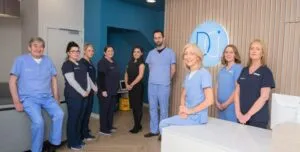
This practice was originally called the Cosgrave Practice and became part of the Dental Care Ireland group in May 2016. It has grown since then and has had a renovation. Located on Watergate Street and still led by principal dentist Dr William Cosgrave, it offers a professional and family-friendly service to the local community in Navan. Its team of dentists, hygienists, dental nurses and admin staff offer general dentistry, orthodontics and cosmetic treatments from its state-of-the-art premises.

To find out more visit our website.
Dental bridge: all you need to know
A dental bridge is an increasingly popular treatment that effectively closes the gap between teeth, leaving you with the perfect smile

As the name suggests, a dental bridge ‘bridges’ the space between your teeth, particularly at the front of your mouth, that may have been caused by missing or decayed teeth. Here we answer all your questions about this treatment.
What is a dental bridges?
A bridge is basically a false tooth that is used to replace a missing one. It is generally inserted between two dental crowns which are put on top of existing teeth. Dental implants also work in certain situations.
As they are natural-looking, no one will notice that you have had a dental bridge. They are also designed and ‘anchored’ in your mouth, so will work exactly like your original teeth.
Why do I need dental bridges?
Having missing teeth can can affect your smile, how you chew and the shape of your mouth. Furthermore, other teeth can begin to move if there is a space in your mouth. Lastly, food can gather in gaps in your teeth, leading to bacteria that can ultimately cause halitosis (bad breath) and decay). Bridges deal with these issues.

Where can I get dental bridges near me?
The following Dental Care Ireland practices around the country offer dental bridges services:
Our partner practice in south County Dublin, Northumberland Dental Care in Dublin 4, also fits bridges.
Is there a dentist near me that does dental bridges?
Yes, with 14 practices nationwide, you will be able to get this treatment done in your local Dental Care Ireland practice.
Can I get dental bridges in Dublin?
The three Dental Care Ireland practices in Dublin – in Cabinteely in Dublin 18, in Knocklyon in Dublin 16 and in Swords in north County Dublin – all provide bridges, as does our partner practice in Dublin 2/Dublin Northumberland Dental Care.
How much do bridges cost?
Bridges range in price depending on the extent of the work necessary. When you attend your dentist, he or she will be able to guide you on the cost of the treatment.
For more on a general guide to fees at Dental Care Ireland practices.
How long do dental bridges last?
Bridges are fairly durable and, if you have a good oral health routine, they can last for five to 15 years and possibly even longer.
How long does it take to get bridges fitted?
This will generally require two to three appointments, one to assess your needs, anchor the teeth or implants so they are ready for the bridges and create moulds of the affected area. Subsequently, you will return to have the bridges fitted.
Do bridges hurt?
In general, they don’t but there may be some discomfort.
What do I need to do once they are fitted?
It is important to maintain good oral hygiene if you have dental bridges, including brushing, flossing and getting regular check-ups. You should also make sure you have a healthy diet. Your dentist will advise you on post-treatment care.
Find out more about dental bridges and other cosmetic dentistry options available from Dental Care Ireland.
You’ll find a list of all our practices nationwide, with full contact details, here: www.dentalcareireland.ie/practices/
